
Insider Tip: Don't study the subject. Study the topics in the subject.
Challenge Yourself: Pick one class and find the topic hiding inside it.
Most law students don't think about law school in topics.
They think about classes.
Contracts.
Torts.
Civil Procedure.
Evidence.
And then they spend the semester moving from reading to class to notes to outlining to studying—often without stopping to define exactly what they're trying to learn.
But a course—or subject—isn't just one thing you learn.
It's a collection of topics you learn. And that changes how you can approach the entire semester.
Start with the big picture: a commercial outline can help you see the major concepts in the subject and understand how they fit together.
Then go to your syllabus: identify the topics your professor will cover this semester.
Now you have the actual building blocks of the course.
And this is where the system comes in: every topic gets run through the same learning system.
You read about it.
You brief cases related to it.
You attend class to deepen and refine your understanding of it.
You build an outline that houses everything you learn about it.
You transform that outline into an exam approach.
You practice writing the topic using the approach. You take multiple-choice sets testing the topic.
You assess your practice performance.
You tweak your topic approaches as you refine your knowledge.
My recent study of 252 law students nationwide found that they don't necessarily move through these study skills in the same order.
Some students need to see the big picture before they can make sense of the details.
Others need to work through the details before the big picture clicks.
The path can be different. The system itself, however, stays consistent.
So whether you're learning offer and acceptance in Contracts, personal jurisdiction in Civil Procedure, or negligence in Torts, you aren't inventing a new way to learn every time you encounter something unfamiliar.
The topic changes.
Your learning preference and thinking style may change how you move through it.
But the study system stays the same.
And that gives you something law school often doesn't. A way to see where you are. A way to know what's next. And a way to make sure you're not just covering material—you’re actually learning it.
Because the goal isn't to have a system for studying Contracts.
It's to have a system for learning every topic inside Contracts.
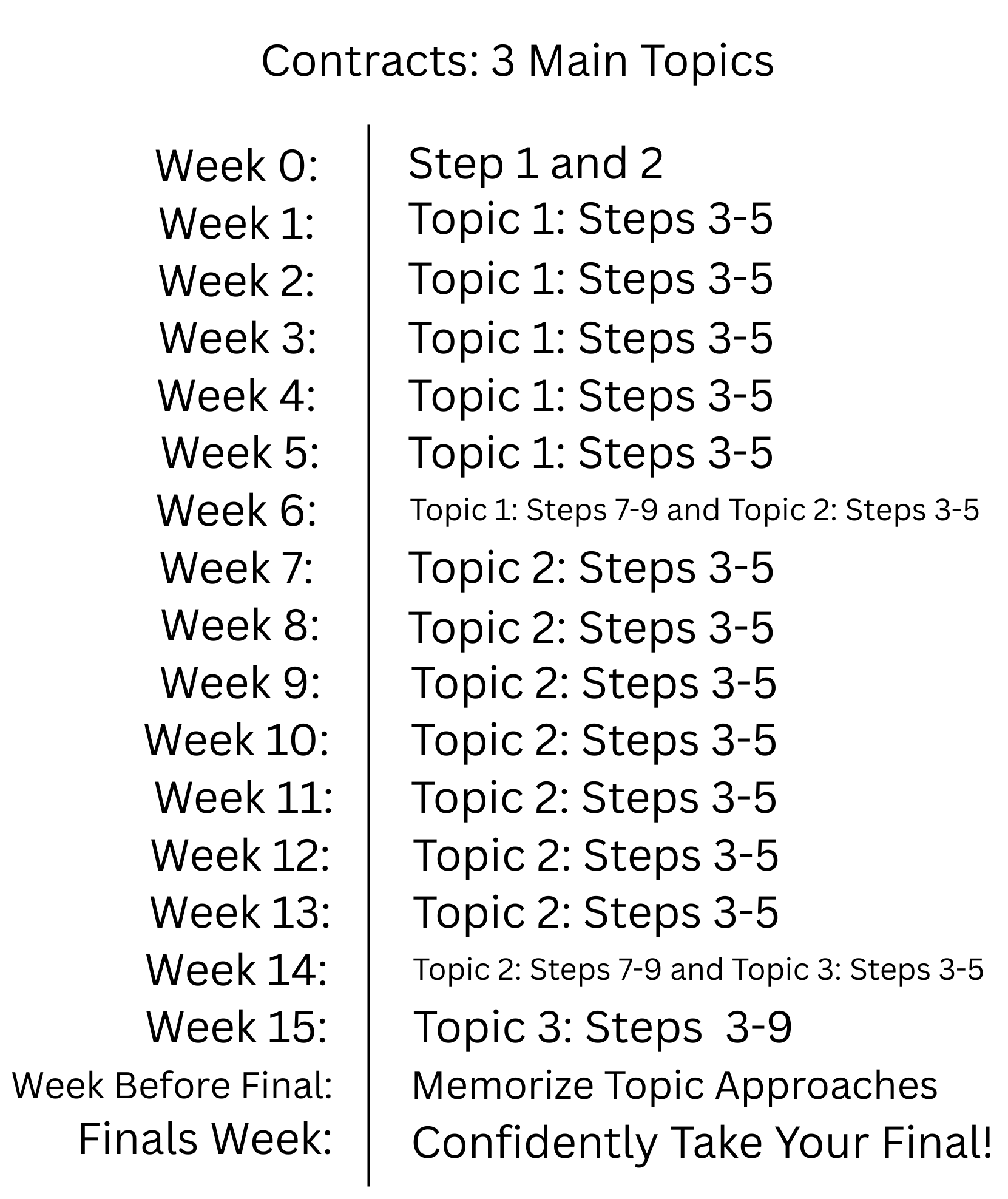
And then you do the same thing in every class, for every topic.
What does your system for learning every topic in each of your classes look like? I'd love to hear from you and read every response!
Have a wonderful weekend. I'm celebrating 47 revolutions around the sun with my most fave people! 🎉
Sending my best,

P.S. I've been busy finishing the final round of edits with my publisher for the second edition of my book, Nine Steps to Law School Success: A Proven Study System No One Teaches You.
In it, I break down the steps top-performing law students use to organize, learn, and write every class topic on exams. Then I share ways to customize the system to your own learning preferences, thinking style, and metacognition.
I can't wait to share it with you (and the world) soon and hope you'll help me pick a cool cover for it! Feels really good to contribute and make life easier for those on the same path, just a few steps behind me.
That's all for this week, thanks for being a part of my community!
Whenever you're ready, here are three ways I help law students achieve their academic goals:
1. Take my course, The Law School Operating System™.
2. Book a 1:1 Coaching Session with me.
3. Contact me to teach my course at your school/institution.

